

Manifest Destiny, Civil War, and Reconstruction (1849 - 1864)

During this era, it was made clear that a theater was the battleground for American Society in regards to numerous social issues. Besides the fact that riots took place in various venues, the theater started to become more relevant to the issues of the time. Shows like A Civil War Christmas addressed social issues and society during the Civil War while communicating the message of family and unity at the same time. Theatre was evolving to become more relevant and meaningful during this time, and growing beyond its original purpose of entertainment.
Astor Place Theater
ASTOR PLACE RIOT
In May 1849, English Actor William Charles Macready was playing the starring role in a performance in New York City. Macready had previously been hissed at by Edwin Forest, another famous actor, and he didn’t want to engage in this rivalry so he moved on. Forrest and his followers developed a hatred towards Macready because they thought he represented aristocratic “snobbery” and people got angry when he was selected to perform at a high-class venue, Astor Place. During this time many Irish immigrants were coming to the US to escape the potato famine and they often fell to urban political machines like Boss Tweed’s Tammany Hall. Macready’s appearance in the US caused a mob led by members of Tammany Hall to attack the theater and its snooty clientele. Twenty-two people were killed and over 100 people were injured. These actors and their protest helped represent the extent of class and ethnic rivalries and the fact that theater was a battleground for American culture.


LINCOLN’S ASSASSINATION
FORD'S THEATER
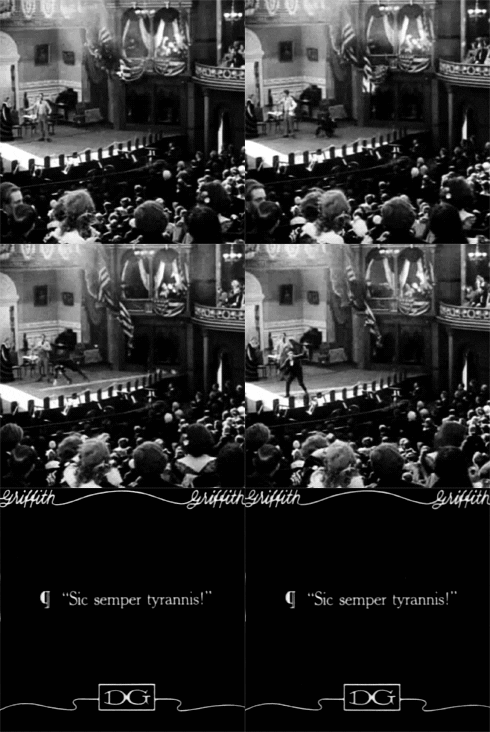

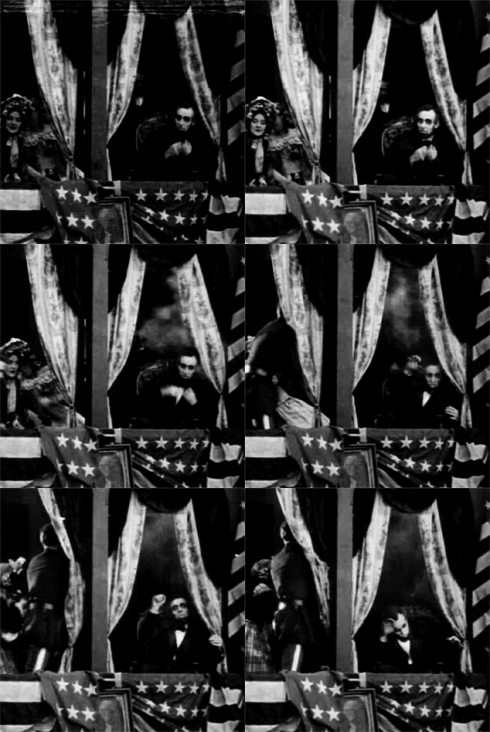
On April 14, 1865, Good Friday, actor John Wilkes Booth learned that President Abraham Lincoln was going to attend a comedy performance of Our American Cousin at Ford’s Theatre that night. Booth had previously performed there multiple times. When he found this out he realized that his moment had arrived. At 10:15 PM the comedy was well into its last act. In the Presidential Box sat President Lincoln, his wife, and their guests. Laughing - not aware of the fact that Booth was just outside the door.
This event showed the fact that theatre was becoming a very popular activity in which people of power and popularity participated. The fact that Lincoln was at a comedy, shows the fact that theatre helped show a sense of eliteness and became an activity for presidents and businessmen.

A CIVIL WAR CHRISTMAS
Playwright Paula Vogel showcases the theme of loss during the Civil War and the idea of renewal after the Civil War during Christmas Time of 1864. Vogel uses the music of the time like carols and more to help tell the story of a cold Christmas Eve in Washington DC. Abraham Lincoln, President at the time, and Mary Todd Lincoln are the main characters of this musical. Lincoln contemplates the way in which he should address the country through his second inaugural address during a time in which the country was divided. The show uses a series of real and fictional characters including Ulysses S. Grant and more.
Hannah and Jessa represent the struggle that African Americans faced during this time period. They sang the song “Follow the Drinking Gourd,” a connection back to Lorraine Hansberry’s “Follow the Drinking Gourd” which was about slavery. This song is heard numerous times throughout the play to show how Hannah’s optimism decreases as time progresses. This is an excerpt from the show:
JESSA: How much further?
HANNAH: Just a couple more bends in the road. We got one more big river to cross.
JESSA: I want to go home.
HANNAH: It’s not home since they sold your father last week. It’s not Home if you and I can’t learn to read. It’s not Home if we can’t go up the road without a paper we couldn’t be taught to read saying we got permission to go up the road! So! We’re gonna find us a Home where I don’t have to watch your back when you get older. Or worry about the Master selling you. Mr. Lincoln said we’re free, and God gave us legs to walk.
JESSA: (unmoved) I’m hungry.
HANNAH: (undeterred by Jessa’s lack of enthusiasm) When we cross the next big river, we’re going to be in the United States of America. And the President there, it’s his job to feed people who don’t have any food, and to find a roof for people who don’t have any houses. So let’s get moving! But you listen up: if we get parted on this side or the other, you’ve got to be careful. Watch out for slave catchers.
JESSA: What do they look like?
HANNAH: If some white man comes up to you and acts nice, and asks where you live, who your mama is, are you lost—you get away from him! Don’t answer. No slave-catcher’s going to get you. (Jessa looks scared.) Look, baby, the stars are coming out. See? There’s the North Star. If you can read the stars, you can find your way North.